 Personal Health & Longevity

Two friends both turn 45 this year. One climbs the stairs at the MRT without thinking. The other feels tired most afternoons and has been told to "watch the cholesterol".
Same birthday age, very different bodies. That gap is what scientists try to capture with the idea of biological age. This guide explains what it means, how it is measured, how much you can trust the number, and how to use it sensibly.
What it is
Your chronological age is simple: the number of years since you were born. Your biological age is an estimate of how old your body seems, based on measurements that change as we age.
Researchers define it in slightly different ways. One widely used approach, called Phenotypic Age, describes it as the age in the general population that matches a person's estimated risk of death.
In the study that validated it, the authors give an example: two people aged 50 could have Phenotypic Ages of 55 and 45. Their risk profiles look like those of an average 55-year-old and an average 45-year-old.
In plain terms:
- A biological age younger than your birthday suggests your measured markers look healthier than average for your age.
- A biological age older than your birthday suggests some markers deserve attention.
It is a summary, not a diagnosis.
Biological age vs chronological age
Chronological age cannot change. Biological age is an estimate that can move over time, because many of its inputs, such as blood sugar, inflammation and fitness, respond to how we live and to good medical care.
How it is measured
There is no single test. Most methods fall into three families.
1. Blood-biomarker clocks
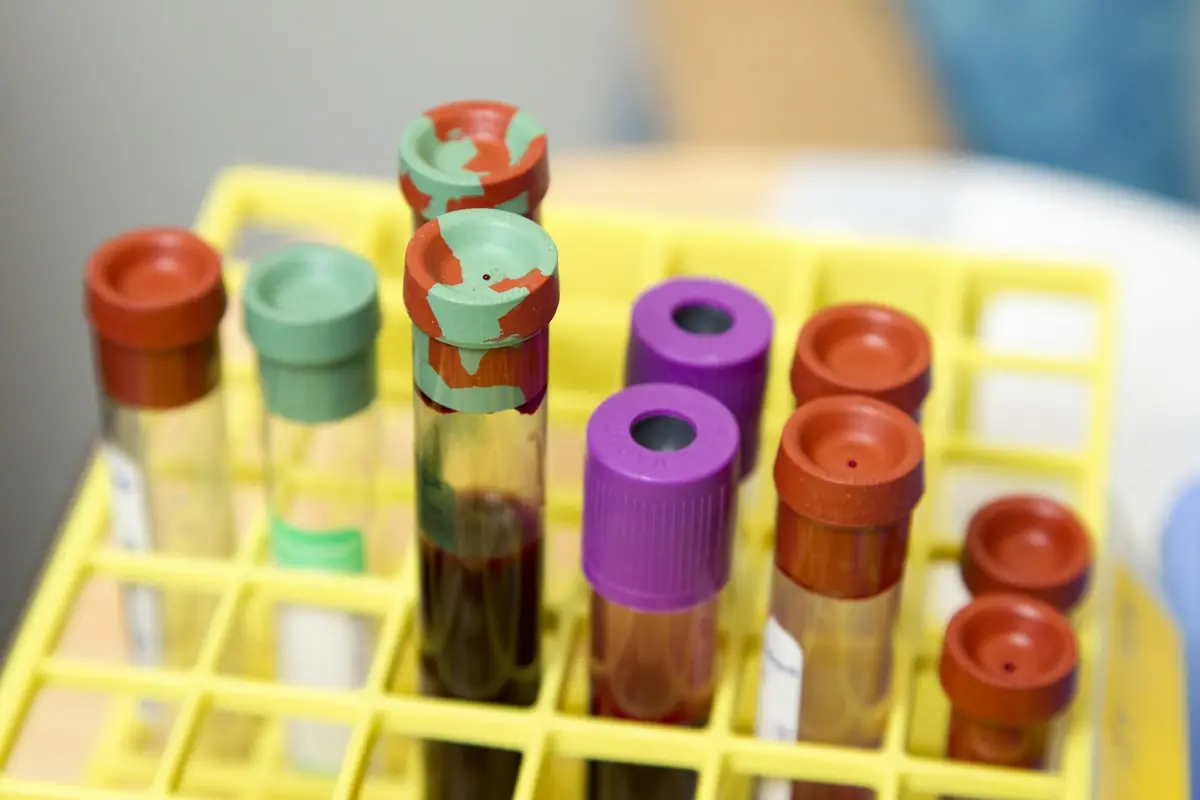
These use routine blood tests plus your age. Phenotypic Age, developed by researchers including Morgan Levine, combines nine blood markers:
- albumin
- creatinine
- glucose
- C-reactive protein (a marker of inflammation)
- lymphocyte percentage
- mean cell volume
- red cell distribution width
- alkaline phosphatase
- white blood cell count
In a study of more than 11,000 US adults, each one-year increase in Phenotypic Age, after accounting for actual age, was linked with a 9% higher risk of death over up to 12.6 years of follow-up. It also predicted risk among people who reported no disease and had a normal BMI.
The appeal of blood-based clocks is that they use tests many labs already run. The limitation is that Phenotypic Age was developed and tested in US national survey data, and its authors say it still needs testing in other groups. So it is less clear how well it fits Asian populations.
2. Epigenetic (DNA methylation) clocks
Our DNA carries chemical tags, called methylation marks, that shift with age. Epigenetic clocks read these marks from a blood or saliva sample.
The best-known early example is the Horvath clock, published in 2013, which uses 353 sites on the genome. In test data it tracked actual age closely, with a typical error of 3.6 years.
Newer clocks aim to predict health outcomes rather than birthday age. One, DunedinPACE, estimates your pace of ageing. It was built by following people born in 1972 to 1973 through 19 measures of organ health, measured four times over two decades.

3. Physiological and wearable signals
Some programmes add measures such as resting heart rate, heart rate variability (HRV), sleep, fitness (VO2 max) and blood pressure.
These are not "clocks" in the research sense. But they show day-to-day patterns that a once-a-year blood test cannot. They are most useful for spotting trends and building habits, not for producing a single precise number.
What about "metabolic age"?
Many body-composition scales show a "metabolic age". This usually compares your estimated resting energy use with age averages. It is a different, much simpler idea and should not be confused with research-based biological age.
How accurate are the tests?
This is the most important question, and the answer is "useful, with caveats".
- Different clocks measure different things. A blood-based score and a DNA-based score for the same person may not agree, because they were built from different data to answer different questions.
- Lab noise matters. A 2022 study in Nature Aging found that technical noise could produce differences of up to 9 years between repeat measurements of the same sample for six well-known epigenetic clocks. Improved methods brought most repeats within 1.5 years.
- One reading is a snapshot. Results can move between tests for reasons other than ageing. The same Nature Aging study, for example, had to correct for short-term changes in the mix of blood cells in a sample.
- It is not a diagnostic test. A biological age result does not tell you whether you have a particular disease. It is a prompt for a good conversation with a doctor.
Why it matters in Singapore
Singaporeans live long lives. Residents' life expectancy at birth reached 83.9 years in 2025.
But living long and living well are not the same. The Global Burden of Disease 2019 study put Singapore's healthy life expectancy at 73.9 years against a life expectancy of 84.9 years: a gap of about 11 years lived with some ill health.
Many risks also go unnoticed. The National Population Health Survey 2024 found that 51.2% of residents with high blood pressure, and 41.3% of those with high cholesterol, had not been diagnosed before the survey.
That is where the idea of biological age can help: it turns abstract risk into something people may want to act on, earlier.
Can you change your biological age?
Because many inputs respond to lifestyle and treatment, the estimate can move. The evidence on how much, and how lasting, is still developing, so be wary of dramatic promises. The foundations that doctors focus on are familiar:
- Regular physical activity, including some that raises your heart rate
- Consistent, sufficient sleep
- A diet built around vegetables, whole grains and lean proteins
- Not smoking, and keeping alcohol low
- Knowing and managing your blood pressure, blood sugar and cholesterol
The number is most helpful as a progress marker alongside your doctor's advice, not as a goal on its own.

Practical tips: reading a result
If you take a biological age test, ask:
- Which method was used? Blood-based, DNA-based, or a mix?
- Who explains it? A doctor should review abnormal markers, not just the headline age.
- What are the next steps? A good report links each finding to a clear action.
- When should I retest? Agree a sensible interval and stick to the same method.
If you do retest, use the same method and, ideally, the same lab. Compare trends over months rather than reacting to one number.
Common questions
Is biological age the same as metabolic age?
No. Metabolic age, shown on many smart scales, compares estimated resting energy use with age averages. Biological age in research uses blood markers, DNA methylation or other health measures linked to long-term health outcomes.
Can a biological age test diagnose disease?
No. A biological age estimate summarises several markers into one number. It can highlight areas worth discussing with a doctor, but diagnosis needs proper clinical assessment and, where needed, specific tests.
How often should I check my biological age?
There is no agreed interval. Ask the doctor who explains your result when a retest would be useful for you. Use the same method each time, because different tests can give different numbers.
Are biological age tests available in Singapore?
Yes. Some screening providers and health programmes in Singapore offer biological age estimates, usually based on blood tests, DNA methylation, or both. Ask how the result is calculated and who will explain it to you.
Further reading and sources
- Liu Z, Kuo P-L, Horvath S, Crimmins E, Ferrucci L, Levine M. A new aging measure captures morbidity and mortality risk across diverse subpopulations from NHANES IV. PLOS Medicine, 2018.
- Horvath S. DNA methylation age of human tissues and cell types. Genome Biology, 2013 (PubMed abstract).
- Belsky DW et al. DunedinPACE, a DNA methylation biomarker of the pace of aging. eLife, 2022 (PubMed abstract).
- Higgins-Chen AT et al. A computational solution for bolstering reliability of epigenetic clocks. Nature Aging, 2022.
- Singapore Department of Statistics, Complete Life Tables for Singapore Resident Population, 2024-2025 (published 3 Jun 2026).
- MOH, Global Burden of Disease 2019 Study Findings.
- MOH, National Population Health Survey 2024 report.
- Background reading: Levine ME et al. An epigenetic biomarker of aging for lifespan and healthspan. Aging, 2018.
More guides: Full body check-up: what a blood test can and can't tell you · What is a good HRV?
This guide is published by the team behind Care+, a personal longevity programme in Singapore.